Showing posts with label April 20. Show all posts

Wednesday, April 20, 2016

FBIs Back Door Searches: Explicit Permission and Before That

I have written numerous times about the timing of authorization for FBI to do back door searches. There’s a passage of the November 6, 2015 FISC opinion finding those searches to be constitutional that some have taken to clearly date the authority. But I believe the (unredacted sections of the) passage are being misread.

As Judge Thomas Hogan describes, “Queries by FBI personnel of Section 702-acquired data…

Screen Shot 2016-04-20 at 8.53.44 PM

As the unredacted parts of the section make clear, queries for both foreign intelligence information or evidence of a crime “have been explicitly permitted by the FBI Minimization Procedures since 2009.” [my emphasis] The footnote goes onto describe how Minimization Procedures approved by Attorney General Mukasey on October 22, 2008 and submitted on some redacted date were approved by an opinion issued on April 7, 2009.

Already, that’s a curious set of details. If the minimization procedures were approved in October 2008, normally they’d be submitted close to right away, though it’s not clear that that happened. In any case, James Clapper’s censors want to hide what those dates were. One likely reason they might have done so would be to hide the dates from defendants, including a few of the ones challenging 702. Another would be to obscure how the approval process went after passage of FISA Amendments Act, specifically given that the FISA Court of Review finalized its Yahoo opinion in August of that year, in which it relied on DOJ’s promise that “there is no database” of incidentally collected US person information.

There Is No Database

But two other things suggest that’s not the end of the story. First, the use of “explicitly” suggests there may have been a period before FISC approved the minimization procedures when such a practice was approved but perhaps not explicitly. Perhaps that simply refers to that lag period, between the time Mukasey approved those minimization procedures and the time FISC approved them.

But then there’s that redacted paragraph (the next footnote, 25, starts after it). Hogan adds something to his discussion beyond his description of the explicit approval of those minimization procedures.

As I have pointed out, Mukasey (writing with then Director of National Intelligence Mike McConnell, who would also have to approve any PRISM minimization procedures) made it clear in response to a Russ Feingold amendment of FISA Amendments Act in February of 2008 that they intended to spy in Americans under PRISM.

So it sure seems likely the Administration at the very least had FBI back door searches planned, if not already in the works, well before FISC approved the minimization procedures in 2009. That’s probably what Hogan explained in that paragraph, but James Clapper apparently believes it would be legally inconvenient to mention that.

The Theory of Business Enterprise Part 1: Introduction

Thorstein Veblen

Thorstein Veblen

Thorstein Veblen wrote The Theory of Business Enterprise in 1904. He is best know for The Theory of the Leisure Class, with its famous phrase, conspicuous consumption. Here’s his Wikipedia entry. There are two things that recommend him to me. First, he studied with Charles Sanders Peirce, one of the central figures of American Pragmatism, and eventually worked with John Dewey, another central figure in the only genuinely American philosophy. Second, he studied with John Bates Clark, one of the earliest neoclassical economists, and rejected his views. In general, he saw the economy as embedded in social institutions, not as an entity on its own. Mark Thoma presents the views of Veblen and Clark on the state of the worker in a capitalist system; the two short pieces will help set the context for this series.

Much of what I have written here is directed at showing that neoliberal economic theory is almost useless as a guide to policy that works for the 99%. The series on Thomas Kuhn’s The Structure of Scientific Revolutions showed that in the hard sciences, successful ideas are been verified and formalized and organized into textbooks to speed up learning. In economics, the academics took the same route. That’s how we got economics textbooks like Samuelson and Nordhaus and Mankiw, both of which are I have addressed in a number of posts. The difference is that practicing economists don’t believe that Econ 101 textbooks are the best understanding of the way the economy works. Those ideas can be quite dangerous. For example, academic economists used models that don’t predict crashes to advise policymakers that deregulating the financial sector would be just fine. That led to the Great Crash. There is no penalty for being wrong. The same old failures just maunder on until death knocks them out of the expert hierarchy. As far as I can tell, they have never managed to excise a single one piece of the arrant nonsense they spout to an ignorant reporter or a politician looking for validation of a crackpot idea. They can’t even kill off the gold standard which is out there today thanks to the supposedly-educated Ted Cruz.

Why is that so? Marion Fourcade and her colleagues have some answers. What I want to do is to examine older books by the dissenters, people who didn’t buy into the silly ideas like this one from The Theory of Political Economy, 1871, by William Stanley Jevons:

I wish to say a few words, in this place, upon the relation of Economics to Moral Science. The theory which follows is entirely based on a calculus of pleasure and pain; and the object of Economics is to maximise happiness by purchasing pleasure, as it were, at the lowest cost of pain.

By “moral science” Jevons means the utilitarian philosophy of Jeremy Bentham. It was Jevons’ intent to translate those ideas into calculus. The discussion was not meant to be humorous. Keynes said that if people knew the principles underlying economics, they’d consider them preposterous, but sadly he was wrong. Nowadays, those ideas are taught to everyone as gospel. Keynes in his time, and I in mine, doubt that academic economists ever read Jevons or Pareto or any of their other intellectual ancestors, let alone the dissenters, including Veblen.

It’s my hope that by reading older books at the boundary of economics and sociology and other disciplines, we can unearth a different tradition and different solutions. And here’s a story.

I went to a sort of book club moderated by a very old man who had long since retired from the University of Chicago where he taught English literature. One of the books he selected was De Rerum Natura, by the Roman writer Lucretius, a fascinating work from about 50 BCE. It’s usually described as an early version of atomic theory. He started by telling us a story. He said that when he was in college he read a lot by the ancient Greeks, plays, philosophy, and even a bit of Euclid. It made him wonder why such smart people would take Greek Mythology seriously, when it was obviously just a bunch of fanciful stories. There were the Sophists who rejected the philosophy of Plato and Aristotle [cf. Zen and the Art of Motorcycle Maintenance by Robert Pirsig], but as we know from Plato, Socrates was condemned to die in part because he did not believe in the gods of Athens. It wasn’t until this session of his book club and his reading of Lucretius that he realized that there were Greeks who flatly rejected the mythology and attempted to conjure up from their limited knowledge a completely material description of the world.

In just the same way, there have always been dissenting economists who offered completely different views of the way a capitalist economy works. The dominant version has concealed the dissenters, not least from themselves, but we are more likely to get a good ideas from the dissenters than from people trying to tweak the dominant structure.

Last July NSA and CIA Decided They Didnt Have to Follow Minimization Procedures and Judge Hogan Is Cool with That

Yesterday, I Con the Record released three FISA Court opinions from last year. This November 6, 2015 opinion, authorizing last year’s Section 702 certifications, has attracted the most attention, both for its list of violations (including the NSA’s 3rd known instance of illegal surveillance) and for the court’s rejection of amicus Amy Jeffress’ argument that FBI’s back door searches are not constitutional. I’ll return to both issues.

I’m surprised, however, that this passage hasn’t generated more attention.

The NSA and CIA Minimization Procedures included as part of the July 15, 2015 Submission each contain new language stating that “[n]othing in these procedures shall prohibit the retention, processing, or dissemination of information reasonably necessary to comply with specific constitutional, judicial, or legislative mandates.” See NSA Minimization Procedures at 1; CIA Minimization Procedures at 4-5. These provisions were not included in the draft procedures that were submitted to the Court in June 2015, but appear to have been added by the government thereafter. They are not discussed in the July 15, 2015 Memorandum.

So basically, NSA and CIA just slipped in language suggesting that they can blow off minimization procedures mandated by Congress, without prior explanation (which is highly unusual in FISA process). The language reminds me of the language NSA used in Intelligence Oversight Board reports to cover up for Stellar Wind. Or the language John Yoo used in his letter to Colleen Kollar-Kotelly saying that FISC couldn’t bind the President.

Thomas Hogan was, to some degree, suitably shocked by this. After laying out how much detail goes into minimization procedures, he said,

A provision that would allow the NSA and CIA to deviate from any of these restrictions based un unspecified “mandates” could undermine the Court’s ability to find the procedures satisfy the above-described statutory requirement.

Ya think?!?!

Hogan then went on to suggest — based on what evidence, he doesn’t say — that the NSA and CIA will only use this language sparingly because the NCTC, which apparently has similar language in their minimization procedures, claimed they’d only use it sparingly.

It appears, however, that the government does not intend to apply these provisions as broadly as their language would arguably permit. In 2012, the government proposed a similar provision as part of minimization procedures to be applied by NCTC in handling certain unminimized terrorism-related information acquired by FBI pursuant to other provisions of FISA. In requesting approval of a provision that would allow NCTC personnel to deviate from other requirements of its minimization procedures when “reasonably necessary to comply with specific constitutional, judicial, or legislative mandates,” the government asserted that “Executive Branch orders or directives will not trigger this provision, nor will general Congressional directives that are not specific to information NCTC receives pursuant to this motion. [citation removed] The Court approved the NCTC minimization procedures with the understanding that this provision would be applied sparingly.The Court described the provision as permitting NCTC personnel to “retain, process or disseminate information when reasonably necessary to fulfill specific legal requirements” and compared it to a more narrowly-drafted provision of separate procedures that permits CIA to retain or disseminate information that is “required by law to be retained or disseminated.”

This language, which if I’m counting correctly, is now in everyone’s minimization procedures but FBI’s, is alarming enough in the NCTC context, which will only get counterterrorism information and that only via FBI.

But CIA and NSA get raw data. Shit-tons of it. Which makes the scale of such language pretty damned alarming.

Having thus assumed the NCTC example is decent precedent for the NSA and CIA adoption, Hogan then does something else amazing. He relies on “informal communications.”

The Court understands based on informal communications between Court staff and attorneys for the government that NSA and CIA intend to apply the similar provisions at issue here in the same narrow manner. In any case, to avoid a deficiency under the above-described definition of “minimization procedures” the Court must construe the phrase “specific constitutional, judicial, or legislative mandates” to include only those mandates containing language that clearly and specifically requires action in contravention of an otherwise-applicable provision of the requirement of the minimization procedures. Such clear and specific language, for instance, might be found in a court order requiring the government to preserve a particular target’s communications beyond the date when they would otherwise be subject to age-off under the minimization procedures. On the other hand, these provisions should not be interpreted as permitting an otherwise prohibited retention or use of information simply because that retention of use could assist the government in complying with a general statutory requirement, such as those stated at 50 U.S.C. § 1881a(b).

This is batshit insane! The court has for years, fought, often unsuccessfully, to keep NSA within the scope of the law as interpreted in minimization procedures. The government slipped in a provision basically saying, if we decide we don’t have to follow minimization procedures mandated by law, we won’t. And Hogan hasn’t required written explanation for why the agencies need this?!?!?!

Hogan does it again in a footnote suggesting the government “may” use this provision to share data with Congress.

The Court understands that the government may have added these new provisions to clarify that information acquired under Section 702 may be shared with Members of Congress or Congressional committees in connection with Congressional oversight of the program. If so, the Court would urge the government to consider replacing these broadly-worded provisions with language that is narrowly tailored to that purpose.

Hey Judge Hogan? The law requiring you approve these minimization procedures and NSA follow them? That law comes from Congress. If Congress needs NSA to start sharing raw data with it (!!!!), then it can change the law. At the very least, don’t you owe your independent branch of government — and the American people — more certainty than that this may explain this alarming provision?

But no. Hogan required nothing in writing. He did require reporting on how NSA and CIA use it. I’m not sure how that’ll be effective when President Trump decides he can pass an Executive Order requiring NSA to keep all the US person data it collects but not tell FISC about it, because the order they report on this to him is part of the minimization procedures they say they can blow off.

And note this is not one of the two areas that Hogan asked amicus Amy Jeffress to weigh in on. Apparently this is either not a “novel or significant interpretation of the law” requiring amicus review or Hogan didn’t include it because it didn’t get included in the June draft, which is when he decided this should have amicus review.

There’s a lot that’s troubling in this opinion. But the most troubling is that the presiding Judge of the FISC court just rubber-stamped NSA and CIA blowing off entirely the minimization procedures that are the core of the FISC’s leverage over the government.

SS7 and NSAs Redundant Spying

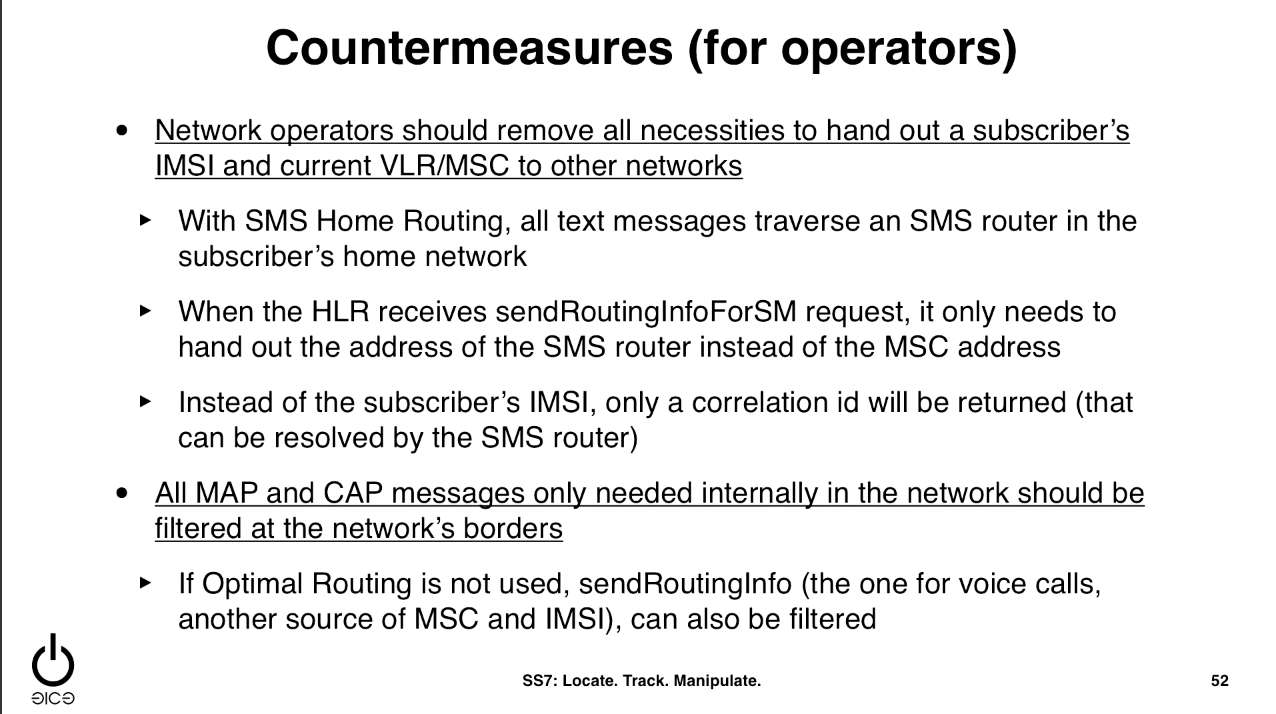
SS7 countermeasuresOn Sunday, 60 Minutes brought attention to an issue first exposed by researchers some years back: the ease with which people can use the SS7 system that facilitates global mobile phone interoperability to spy on you.

Sharyn Alfonsi: If you just have somebody’s phone number, what could you do?

Karsten Nohl: Track their whereabouts, know where they go for work, which other people they meet when– You can spy on whom they call and what they say over the phone. And you can read their texts.

60 Minutes was smart in that they got Congressman Ted Lieu to agree to be targeted.

Congressman Lieu didn’t have to do anything to get attacked.

All Karsten Nohl’s team in Berlin needed to get into the congressman’s phone was the number. Remember SS7 –that little-known global phone network we told you about earlier?

Karsten Nohl: I’ve been tracking the congressman.

[snip]Sharyn Alfonsi: Are you able to track his movements even if he moves the location services and turns that off?

Karsten Nohl: Yes. The mobile network independent from the little GPS chip in your phone, knows where you are. So any choices that a congressman could’ve made, choosing a phone, choosing a pin number, installing or not installing certain apps, have no influence over what we are showing because this is targeting the mobile network. That of course, is not controlled by any one customer.

[snip]

Sharyn Alfonsi: What is your reaction to knowing that they were listening to all of your calls?

Rep. Ted Lieu: I have two. First, it’s really creepy. And second, it makes me angry.

Sharyn Alfonsi: Makes you angry, why?

Rep. Ted Lieu: They could hear any call of pretty much anyone who has a smartphone. It could be stock trades you want someone to execute. It could be calls with a bank.

Karsten Nohl’s team automatically logged the number of every phone that called Congressman Lieu — which means there’s a lot more damage that could be done than just intercepting that one phone call.

So now Lieu is furious — and pushing House Oversight Committee to conduct an investigation into SS7’s vulnerabilities.

Of course, it’s probably best to think of SS7’s vulnerabilities not as a “flaw,” as 60 Minutes describes it, but a feature. The countries that collectively aren’t demanding change are also using this vulnerability to spy on their subjects and adversaries.

But the fact that Lieu — who really is one of the smartest Members of Congress on surveillance issues — is only now copping onto the vulnerabilities with SS7 suggests how stunted our debate over dragnet surveillance was and is. For two years, we debated how to shut down the Section 215 dragnet, which collected a set of phone records that was significantly redundant with what we collected “overseas” — though in fact the telecoms’ production of such records was mixed together until 2009, suggesting for years Section 215 probably served primarily as legal cover, not the actual authorization for the collection method used. We had very credulous journalists talking about what a big gap in cell phone records NSA faced, in part because FISC frowned on letting NSA collect location data domestically. Yet all the while (as some smarter commenters here have said), NSA was surely exploiting SS7 to collect all the cell phone records it needed, including the location data. Members of Congress like Lieu — on neither the House Intelligence (which presumably has been briefed) or the House Judiciary Committees — would probably not get briefed on the degree to which our intelligence community thrives on using SS7’s vulnerabilities.

What I find perhaps most interesting about this new flurry of attention on SS7 is that the researchers behind it were hired by some “international telecoms” to find ways to improve security sometime in advance of December 2014 (when they first presented their work). The original CCC presentation on this vulnerability (see after 40:00) included a general discussion of what cell phone providers could do to increase the security of their users (see above). 60 Minutes noted that some US providers were doing more than others.

The NSA presumably could and did use entirely SS7 collection for cell phones — especially US based ones — until such time as domestic providers started making them less accessible (and once they were unaccessible overseas, then subject to legal process, though even some of the countermeasures would still leave a US user exposed to other US providers). That needs to be understood (should have been, before the passage of USA Freedom) to really understand the degree to which Congress has any influence over the NSA.

Wednesday Morning: Water Water Everywhere

[image (mod): LeAnn E. Crowe via Flickr]

[image (mod): LeAnn E. Crowe via Flickr]

Day after day, day after day,
We stuck, nor breath nor motion;
As idle as a painted ship
Upon a painted ocean.

Water, water, every where,
And all the boards did shrink;
Water, water, every where,
Nor any drop to drink.

— excerpt, The Rime of the Ancient Mariner by Samuel Taylor Coleridge

Felony and misdemeanor charges are expected today in the Flint water crisis. State Attorney General Bill Schuette will put on a media dog-and-pony show, when it is expected that three persons — two engineers with the Michigan Department of Environmental quality and a Flint water department employee — will be charged for Flint’s lead water levels after the cut-over to Flint River water.

Mind you, the descriptions of these persons do not match that of higher level persons who were responsible for

1) making the final decision to cut Flint off from Detroit’s water system and switching to the Flint river;
2) evaluating work performed by consulting firms about the viability of Flint River as a water source, or about reporting on lead levels after the cut-over;
3) ensuring the public knew on a timely basis the water was contaminated once it was already known to government officials;
4) lack of urgency in responding to a dramatic uptick in Legionnaire’s disease, or the blood lead levels in children.

Just for starters. Reading the Flint water crisis timeline (and yes, it needs updating), it’s obvious negligence goes all the way to the top of state government, and into the halls of Congress.

Michigan’s Governor Snyder has elected to perform some weird self-flagellating mea culpa or performance art, by insisting he and his wife will drink filtered Flint city water for a month. It’s a pointless gesture since the toxic lead levels, experienced during the two years immediately after the city’s cut-over to the Flint River, have already fallen after doing permanent damage to roughly eight thousand children in and around Flint.

Flint’s Mayor Karen Weaver said about the governor’s stunt, “[H]e needs to come and stay here for 30 days and live with us and see what it’s like to use bottled or filtered water when you want to cook and when you want to brush your teeth.”

Or get a new mortgage, I would add. The gesture also does nothing for Flint’s property values. Imagine living in Flint, trying to refinance your home to a lower interest rate, telling the bank, “Oh, but the water’s safe enough for the governor!” and the bank telling you, “Nah. Too risky.”

I’ll post some tech and business stuff here after I cool off. Sometimes researching and writing this morning roundup stuff raises my blood pressure, but when it comes to Flint…%^&/>*#@!!!